
Didactic proposal on health risk assessment of atmospheric toxic substances
Article Sidebar
Main Article Content
Abstract
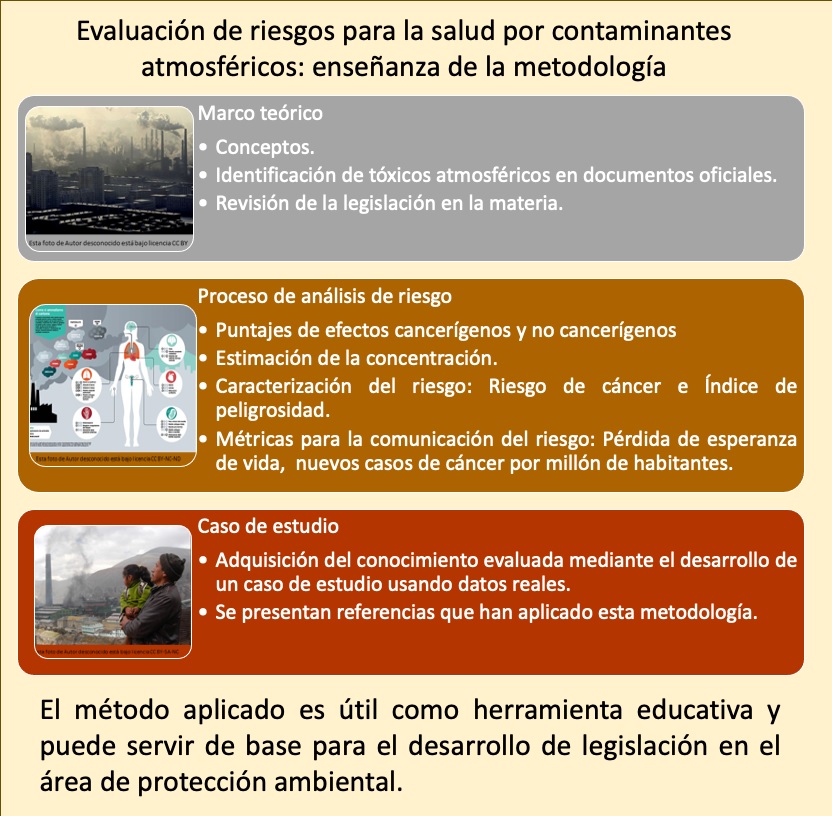
In Mexico, the regulatory framework mandates that industrial sectors engaging in high-risk activities must submit an environmental risk assessment for specific scenarios such as spills, leaks, fires, or explosions. However, this requirement does not consider the potential impacts that may arise from the daily operations of industries that continuously release toxic substances into the atmosphere. While air quality assessments are conducted based on maximum permissible limits of criteria pollutants aimed at protecting public health, there are no instruments in place that require industry to conduct a risk analysis for the health of the population exposed to atmospheric pollutants that they themselves emit. In this work, a methodological proposal is presented to teach the evaluation of these risks, which begins with the theoretical framework, the United States Environmental Protection Agency (EPA) risk assessment procedure and common indices for risk communication. The evaluation process includes a case study that uses information from the Pollutant Release and Transfer Registers (PRTR), as well as the California Air Resources Board’s Consolidated Table. In addition, other references are provided that show case studies developed with this methodology, which have allowed the identification of sources and substances that could represent a potential risk to human health and the environment. This work can serve as a guide for the development of teaching materials and environmental legislation on the subject.
Article Details
Citas en Dimensions Service


References
Altúzar Villatoro, F. (2024). Identificación de riesgos por emisiones de sustancias tóxicas en la región de Tula, Hidalgo[Tesis de maestría no publicada]. Universidad Nacional Autónoma de México.
California Environmental Protection Agency. (2015). The air toxics hot spots program guidance manual for preparation of health risk assessments. https://oehha.ca.gov/media/downloads/crnr/2015guidancemanual.pdf
California Air Resources Board. (2022). Consolidated table of OEHHA/ARB approved risk assessment health values.https://ww2.arb.ca.gov/es/resources/documents/consolidated-table-oehha-carb-approved-risk-assessment-health-values
Carmona Villavicencio, A. (2006). Evaluación de riesgos de tóxicos atmosféricos: formaldehído en la Ciudad de México [Tesis de licenciatura, Universidad Nacional Autónoma de México]. Tesiunam. http://132.248.9.195/pd2006/0608249/Index.html
Environmental Protection Agency. (2018). EPA’s Air Toxics Screening Assessment [Technical Report]. https://www.epa.gov/system/files/documents/2023-02/AirToxScreen_2018%20TSD.pdf
Environmental Protection Agency. (2022). Risk Assessment. https://www.epa.gov/risk
Environmental Protection Agency. (2024). Conducting a Human Health Risk Assessment.https://www.epa.gov/risk/conducting-human-health-risk-assessment
Gratt, L. B. (1996). Air toxic risk assessment and management: Public health risk from normal operations. John Wiley & Sons.
Giuliani, D., Mellado, D., y Lerner, J. E. C. (2021). Atmospheric Pollution. In Air Pollution: Effects and Dangers (p. 52). Nova Science Publisher, Inc.
House of Representatives, C. (2016). 42 U.S.C. 7412 - Hazardous air pollutants. In U.S. Code: U.S. Government Publishing Office.
Ley General de Equilibrio Ecológico y Protección al ambiente. (2024, 24 de enero). Diario Oficial de la Federación.Cámara de Diputados del H. Congreso de la Unión. https://www.diputados.gob.mx/LeyesBiblio/pdf/LGEEPA.pdf
Martínez Catana, N. (2012). Evaluación preliminar de riesgos a la salud por inhalación de tóxicos atmosféricos en la Ciudad de México de junio a diciembre de 2011 [Tesis de licenciatura, Universidad Nacional Autónoma de México]. Tesiunam. http://132.248.9.195/ptd2012/agosto/0683558/Index.html
Martín-Olmedo, P., Carroquino Saltó, M. J., Ordóñez Iriarte, J. M., y Moya, J. (2016). La evaluación de riesgos en salud. Guía metodológica. Aplicaciones prácticas de la metodología de evaluación de riesgos en salud por exposición a químicos.https://www.researchgate.net/publication/311087127_La_Evaluacion_de_Riesgos_en_Salud_Guia_metodologica
Perry, S. G., Cimorelli, A. J., Paine, R. J., Brode, R. W., Weil, J. C., Venkatram, A., y Peters, W. D. (2005). AERMOD: A dispersion model for industrial source applications. Part II: Model performance against 17 field study databases. Journal of Applied Meteorology, 44(5), 694-708.
Rivera Domínguez, C. H. (2009). Evaluación de riesgo ambiental por la industria del estado de Querétaro en operación normal [Tesis de licenciatura, Universidad Nacional Autónoma de México]. Tesiunam. http://132.248.9.195/ptd2009/agosto/0646301/Index.html
Scire, J. S., Strimaitis, D. G., y Yamartino, R. J. (2000). A user’s guide for the CALPUFF dispersion model. Earth Tech, Inc, 521, 1–521.
Secretaría de Medio Ambiente y Recursos Naturales. (2002). Norma Oficial Mexicana NOM-040-SEMARNAT-2002. Protección ambiental-Fabricación de cemento hidráulico- Niveles máximos de emisión a la atmósfera. Diario Oficial de la Federación. https://www.profepa.gob.mx/innovaportal/file/1236/1/nom-040-semarnat-2002.pdf
Secretaría de Medio Ambiente y Recursos Naturales. (2004). Norma Oficial Mexicana NOM-098-SEMARNAT-2002, Protección ambiental-Incineración de residuos, especificaciones de operación y límites de emisión de contaminantes.Diario Oficial de la Federación. https://www.profepa.gob.mx/innovaportal/file/1309/1/nom-098-semarnat-2002.pdf
Secretaría de Medio Ambiente y Recursos Naturales. (2014). Norma Oficial Mexicana NOM-165-SEMARNAT-2013, Establece la lista de sustancias sujetas a reporte para el registro de emisiones y transferencia de contaminantes. Diario Oficial de la Federación. https://www.profepa.gob.mx/innovaportal/file/6640/1/nom-165-semarnat-2013.pdf
Secretaría de Medio Ambiente y Recursos Naturales. (2015). Norma Oficial Mexicana NOM-166-SEMARNAT-2014, Control de emisiones atmosféricas en la fundición secundaria de plomo. Diario Oficial de la Federación. https://www.dof.gob.mx/nota_detalle.php?codigo=5378252&fecha=09/01/2015#gsc.tab=0
Secretaría de Medio Ambiente y Recursos Naturales. (2018, 13 de agosto). Estudios de riesgo e impacto ambiental.https://www.gob.mx/semarnat/acciones-y-programas/estudios-de-riesgo-e-impacto-ambiental
Secretaría de Medio Ambiente y Recursos Naturales. (2021). Actividades consideradas como altamente riesgosas. https://acortar.link/obRxcl
Stein, A., Draxler, R. R., Rolph, G. D., Stunder, B. J., Cohen, M., y Ngan, F. (2015). NOAA’s HYSPLIT atmospheric transport and dispersion modeling system. Bulletin of the American Meteorological Society, 96(12), 2059–2077.
Vázquez Bautista, L. (2023). Evaluación del riesgo por emisiones de tóxicos atmosféricos para México en 2018 a partir del Registro de Emisiones y Transferencia de Contaminantes (RETC) [Tesis de licenciatura, Universidad Nacional Autónoma de México]. Tesiunam. http://132.248.9.195/ptd2023/marzo/0837371/Index.html
Vega, E., López-Veneroni, D., Ramírez, O., Chow, J. C., y Watson, J. G. (2021). Particle-bound PAHs and Chemical Composition, Sources and Health Risk of PM2.5 in a Highly Industrialized Area. Aerosol and Air Quality Research, 21(10), 210047. https://doi.org/10.4209/aaqr.210047
Vega, E., Ramírez, O., Sánchez-Reyna, G., Chow, J. C., Watson, J. G., López-Veneroni, D., y Jaimes-Palomera, M. (2022). Volatile Organic Compounds and Carbonyls Pollution in Mexico City and an Urban Industrialized Area of Central Mexico. Aerosol and Air Quality Research, 22(6), 210386. https://doi.org/10.4209/aaqr.210386
Villarón Calderón, E. (2007). Riesgo ambiental por contaminantes criterio y contaminantes peligrosos en dos sitios de la Ciudad de México [Tesis de licenciatura, Universidad Nacional Autónoma de México]. Tesiunam. http://132.248.9.195/pd2007/0620592/Index.html

Educación Química por Universidad Nacional Autónoma de México se distribuye bajo una Licencia Creative Commons Atribución-NoComercial-SinDerivar 4.0 Internacional.
Basada en una obra en http://www.revistas.unam.mx/index.php/req.