
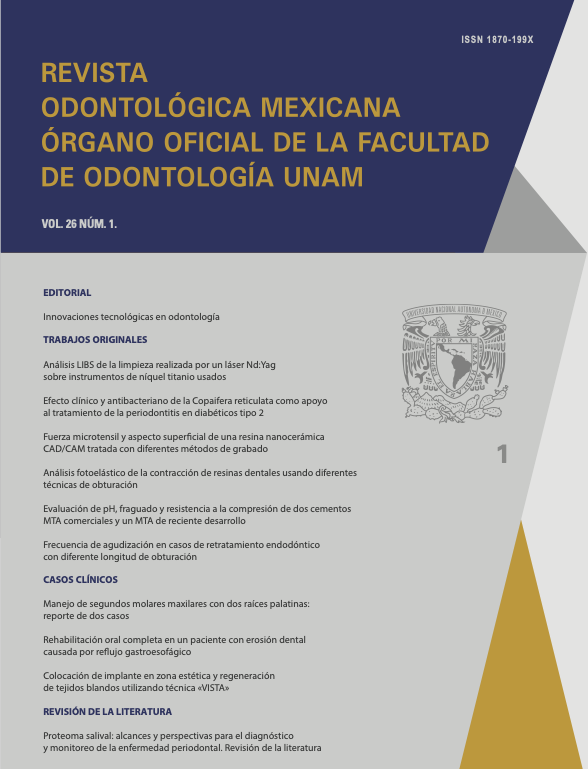
Frecuencia de agudización en casos de retratamiento endodóntico con diferente longitud de obturación
Barra lateral del artículo
Contenido principal del artículo
Resumen
Introducción: la remoción completa de materiales de obturación y dentina contaminada del conducto radicular durante el retratamiento endodóntico puede influir en la aparición de agudización endodóntica. Objetivo: establecer la frecuencia de agudización endodóntica posterior al retratamiento endodóntico de dientes anterosuperiores con diferente longitud de obturación apical. Material y métodos: se eligieron 33 casos con fracaso endodóntico para este estudio. Según la longitud apical de la obturación inicial, los sujetos se dividieron en dos grupos: el grupo A (n = 23) fueron casos obturados entre 0.0 y 2.0 mm al ápice radiográfico (AR) y el grupo B (n = 10) casos obturados entre 2.1 y 6 mm cortos al AR. Las obturaciones con gutapercha se eliminaron con instrumentos ProTaper retreatment D1 a D3 (Dentsply-Sirona, Ballaigues, Switzerland) más cloroformo. Posteriormente los conductos radiculares se instrumentaron con limas K-flexofile. Los casos reinstrumentados fueron obturados con gutapercha (Higyenic, Coltene Whaledent) y Sealapex (Kerr Sybronendo, WA) durante la misma cita. Los pacientes tomaron 400 mg de ibuprofeno cada ocho horas durante 72 horas y registraron el dolor postoperatorio a las ocho, 24, 48 y 72 horas. Se definió como agudización la aparición de dolor severo y/o inflamación (dolor en escala Heft-Parker a partir de 114 mm). Se determinaron porcentajes de casos positivos a la palpación y percusión a las 72 horas en ambos grupos. Resultados: dos pacientes presentaron agudización (6%), ambos en el grupo A. El dolor postoperatorio fue de 21.2% en los pacientes del grupo A a las ocho horas y 9.1% a las 48 horas. No se encontraron diferencias estadísticamente significativas en la presencia de agudización entre grupos (p > 0.05). Conclusiones: la agudización de casos de retratamiento endodóntico es de 6%. La longitud de obturación de casos indicados para retratamiento endodóntico no influye en la frecuencia de agudización postoperatoria.
Detalles del artículo
Citas en Dimensions Service

Revista Odontológica Mexicana por Universidad Nacional Autónoma de México se distribuye bajo una Licencia Creative Commons Atribución-NoComercial-SinDerivar 4.0 Internacional.
Basada en una obra en http://revistas.unam.mx/index.php/rom.