
Working posture and its relationship with the development of future musculoskeletal disorders in dental students at the Catholic University of Cuenca, Ecuador
Article Sidebar
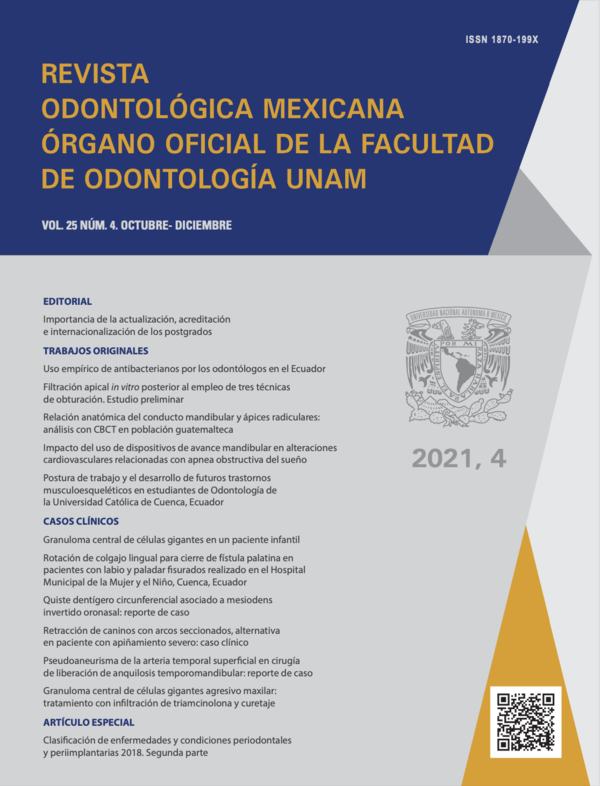
Main Article Content
Abstract
Introduction: the practice of inadequate postures and repetitive movements are frequent in the dental practice, carried out to achieve better visibility of the operative field, leading the professional to physical fatigue, maintaining this type of work posture for a prolonged period can develop musculoskeletal alterations. Objective: to analyze the working position and the type of muscle-tendon pain in fifth-year dental students of the Catholic University of Cuenca, Ecuador. Material and methods: cross-sectional, descriptive study was carried out using visual analysis and an evaluation of musculoskeletal disorders in 125 fifth-year students of the dental career at the Catholic University of Cuenca, Ecuador, obtaining the sample in a population of 185 students. To evaluate the type of muscle-tendon pain present in the students we used the Kuorinka Nordic questionnaire and to determine the working position of the students in the dental unit we used the BHOP postural checklist. Results: the Nordic questionnaire showed that 67.2% (n = 84) of the participants evaluated presented pain, compared to 32.8% (n = 41) of the participants who did not present pain. It was notorious the presence of pain at the back level with 37.2% (n = 71), followed by neck pain with 30.4% (n = 58); right hand and wrist with 12.6% (n = 24); right shoulder with 6.8% (n = 13); left shoulder and right elbow-forearm corresponding to 4.7% (n = 9) each, with left elbowforearm with 2.1% (n = 4) and left hand-wrist with 1.6% (n = 3). The results of the BHOP postural checklist indicated that 1.6% (n = 2) have maximum balance position, but 98.4% (n = 123) possess inadequate working posture. Conclusions: the working postures verified during the clinical procedures were mostly incorrect, and
inadequate posture maintained for a prolonged time can develop long-term musculoskeletal alterations, in an initial phase pain, limited body mobility, and recurrent muscle spasms are present.
Article Details
Citas en Dimensions Service

Revista Odontológica Mexicana por Universidad Nacional Autónoma de México se distribuye bajo una Licencia Creative Commons Atribución-NoComercial-SinDerivar 4.0 Internacional.
Basada en una obra en http://revistas.unam.mx/index.php/rom.