Introduction
TRANSDISCIPLINE HAS BECOME a paradigm towards which all academic research systems
shall evolve, considering that our complex socio-environmental problems require new
knowledge production approaches to understand these phenomena and provide clearer
and more comprehensive alternative solutions. Today, socio-environmental transformations
occur at global scales, albeit with particular characteristics in each territorial
context.
This paper analyzes the experience of a research group working in Yucatan, Mexico,
seeking the joint production of knowledge about sustainable housing to address precarious
households in the outskirts of Merida, the capital city of the state of Yucatan. This
city enjoys a positive image at national and international levels, supported by high
safety and quality-of-life indices (Bolio 2014). As a result, immigration has increased, leading to accelerated urban growth that
has boosted housing construction projects. This phenomenon has influenced in the increase
of land, construction, and real estate prices (Combaluzier 2021).
At the same time, Merida also experienced decades of immigration of rural populations
into the city in search of better job opportunities and urban services. Some of these
groups settled in periurban areas of southern Merida, where communities have faced
difficulties buying their own houses, in addition to household overcrowding and self-construction,
frequently unfinished. In turn, the city has historically experienced a high socio-spatial
segregation where the northern zone enjoys important privileges while the southern
one has been relegated (López 2019).
Within this framework, in December 2020, the research group undertook a project to
seek sustainable housing solutions in Merida, Yucatan, through technological innovations,
submitting it to the National Council of Science and Technology (Conacyt, in Spanish),
the agency of the Mexican federal government in charge of scientific and technological
development.1 It is worth noting that the current federal government has sought to focus the research
agenda on environmental sustainability issues, aimed at addressing social needs and
national problems. This led to the formation of an inter and transdisciplinary team
involving different academic institutions, local government agencies, civil society
organizations, citizen groups, and social-based organizations living on the periphery
of the city.
The present work analyzes the achievements in the work team multisectoral conformation
and the obstacles and limitations faced during this experience. It is important to
point out that this is not a research paper, but rather a narrative, critical and
reflective process based on the experience of the authors as participants in an inter
and transdisciplinary research group, with the purpose of contributing empirically
to the analysis of the implications of these methods for the production of new knowledge
and the solution of concrete problems, as in the case of sustainable social housing.
The paper begins with a conceptual review of sustainable housing and inter and transdisciplinary
research. It then discusses the new orientations that are being given in the federal
scientific and technological policy. Subsequently, the local context in which the
studied project was carried out is analyzed, as a prelude to the presentation of the
experience studied and the analysis of the challenges that arose in the development
of the research, in the new policy framework, especially regarding the dialogue between
participants from different disciplinary fields and diverse social sectors. Next,
the involvement of the communities of the peripheral areas of Merida, Yucatan in the
project is addressed, particularly through the development of participatory workshops.
Finally, reflections from the analysis of this experience are presented.
About the notion of sustainable housing
Housing is the most intimate space of the humans who inhabit it and although from
an administrative perspective it is a habitable material space, it also reflects sensitive
spaces of the way of life, cultural identities, family needs and climatic conditions,
representing the complexity of social relations that must be satisfied (García 2021). While for some privileged social groups, it is a reflection of aesthetic styles
and preferences, for the most vulnerable groups it is a result of their economic possibilities
and limitations (Canché et al. 2024). Therefore, the issue of housing needs to be approached from different disciplinary
approaches, such as architecture, urban planning, engineering, sociology, political
science, environmental science and anthropology, to mention a few; which is a reference
for the inter and transdisciplinary approach of the team formed for sustainable housing
in periurban areas of Merida, which is analyzed in this paper.
Housing is a basic right, as enshrined in Article 4 of the Mexican Constitution, according
to which “every family has the right to enjoy decent and dignified housing”. However,
the housing of vulnerable populations represent different problems such as the insecurity
of the materials with which they are made, overcrowding, lack of public water, sanitation
or electricity services, and even their settlement in unsafe or at-risk areas (Canché et al. 2024). Moreover, in many cases these social groups do not enjoy security or property certainty,
having to improvise their homes in precarious conditions, many in rented or other
relatives’ homes, or in unfinished projects, all of which deteriorate their quality
of life (Cruz et al. 2024). It is considered that in Latin America these scenarios are faced by popular settlements
that constitute 60 to 70% of urban areas (Fidel and Romero 2017).
Thinking about the habitability of housing in contemporary societies also requires
considering sustainability. This is an essential factor if we consider that the increased
urbanization processes have contributed significantly to aspects such as the fragmentation
of ecosystems, changes in land use, reduction of fo- rest areas and many other socio-environmental
impacts that entail risks for cu- rrent and future populations, which increase in
vulnerable areas. It is therefore necessary to consider sustainability criteria in
low-income housing throughout the entire life cycle of the building, from design,
construction and operation to its destruction (Solís, Robles and Rodríguez 2020).
Sustainable housing has been conceived from different perspectives that include the
architectural -use of efficient life and long useful life of the building-, and the
institutional quality of housing and the environment that favor the responsibility
of neighbors with their community (González-Yñigo and Méndez-Ramírez, 2018). Therefore, from this second point of view, in Mexico, sustainable housing, in addition
to considering environmentally friendly criteria, links a sustainable operation in
terms of energy and water saving, for which the incorporation of eco-technologies
is required (Infonavit [2010] cited in González-Yñigo and Méndez-Ramírez, 2018), such as solar cells or wastewater treatment plants.
Fidel and Romero (2017) specify that the use of ecotechnologies in the design and construction of housing
requires a participatory approach, where the knowledge and perspectives of the populations
involved are integrated to the specialized technical knowledge. Experience has shown
that participatory processes generate more solidarity and commitment among inhabitants,
allowing a greater collective appropriation of spaces, as opposed to planned real
estate projects, many of which have an industrialized and unsustainable production.
In short, the interaction between multiple knowledges can lead to better solutions,
overcoming the problems generated by a technocratic vision of housing (Fidel and Romero 2017), a line that was also traced in the call from which the project analyzed in this
paper arose.
In this tenor, some factors of sustainable housing referred to in this topic’s literature
include the materials used for construction, which generate the lowest possible environmental
cost, systems for the rational consumption of water and energy, natural ventilation
and lighting, optimization of living space and even the reuse of materials at the
end of their useful life (Mingüer 2017). Sustainable housing also involves overcoming the anthropocentric vision that governs
the idea that humans can take over any territory and adapt it to our needs and tastes,
including other criteria related to the reduction of ecological impacts in the transformation
of natural spaces (Mingüer 2017).
In line with the above, the call to which this project subscribed stated that “one
of the particular objectives of Conacyt in terms of research on sustainable housing
and cultural and environmental relevance [...] is to promote the formation of interdisciplinary,
inter-institutional and cross-sectoral research and advocacy groups that understand,
in their complexity, the fundamental problems of housing and, in general, of habitat”
(Conacyt 2020a). To this end, it motivated the enunciation of proposals aligned with SDG 11 that
included, among other aspects, approaches to climate change mitigation; buildings
resilient to disaster risks and public health; collaborative innovations for the development
of technological systems; optimization of the life cycle of housing from a circular
pers- pective; articulation to the regional vision of adequate housing and sustainable
cities; and housing as a mechanism for food security and sovereignty (Conacyt 2020b).
In the project analyzed here, particular aspects of sustainability in housing were
considered in the context of the subtropical climatic environment of a city like Merida,
where high temperatures and humidity conditions remain throughout the year. Therefore,
some sustainable strategies contemplated the design of environments with cross ventilation,
which allows regulating the high temperatures of the environment, the generation of
shadows to prevent overheating, a greater use of vegetation (trees or green walls)
and design of roofs and walls that provide shade (Canché et al. 2024). Another crucial aspect was the development and use of ecological materials to replace
more traditional cement-based materials, and the replacement of natural wood with
plastic or composite plastic wood, in order to reduce deforestation, allowing the
use of other natural fibers whose residues can be reused (e.g., agave bagasse, sugarcane,
rice husks, etc.) (Canché et al. 2024).
Semblance of inter and transdiscipline as approaches to socioenvironmental research
The inter and transdiscipline concepts are closely related to the sustainability challenges
emerging over several decades to preserve life on Earth. These imply understanding
highly complex (Morin 1990; García 2006) and dynamic socio-environmental issues, which remain permanently uncertain (Funtowicz and Ravetz 1999). Both inter and transdiscipline stem from new configurations of academic research
teams that require expanding their own epistemological conceptions to achieve a greater
impact on the transformation of reality (Giraldo and Arancibia 2023).
Various disciplines come into contact in interdisciplinary research, modifying their
methodological structures and leading to interdependency, ultimately resulting in
the integration and enrichment of knowledge (Torres 2000). It should be noted that work teams include specialists from different fields of
knowledge and disciplines, meaning that interdisciplinarity is a characteristic of
research processes rather than work teams, which are multidisciplinary.
Transdiscipline is considered a higher stage of interdisciplinarity (Delgado 2019), where it is essential to include various population interests and values (Klein 2008) to influence the transformation of socio-environmental problems. This involves the
need to incorporate non-scientific knowledge provided by different social stakeholders,
which contribute, from diverse experiences, perspectives, and worldviews, to understanding
complex issues within specific territorial scenarios.
The above means that transdiscipline is needed for both theoretical and practical
perspectives (Luengo 2012), which implies the impact on the design of better public policies and the collaboration
with various social actors to solve a specific issue. Consequently, in transdiscipline,
methodological and theoretical boundaries fade away to integrate practical, technical,
or traditional knowledge through intercultural dialogue to produce a novel knowledge
system about a phenomenon that science itself could not totally explain or solve on
its own (Delgado 2019; Luengo 2009).
One approach to undertake transdisciplinary work is through Participatory Action Research
(IAP, in Spanish), which contributes to social change as it can potentially increase
the influence of participants to promote this transformation. It can also foster the
development of the community involved, promote leaders, solve issues according to
their priority, stimulate self-help, and strengthen solidarity and collaboration among
community members (Balcázar 2003).
In practice, thinking about transdiscipline implies an aspiration rather than an attained
goal and entails a paradigmatic revolution. This approach will require a gradual change
in the traditional way of organizing academic communities and improving communication
or “translation” and mediation processes during the dialogue between multiple languages,
values and interests (Luna and Velasco 2021). This aspect is analyzed in the interaction between the heterogeneous actors who
were members of the research group discussed in this work.
Orientation of public policy in science and technology in Mexico and strategic national
programs
The current Mexican government, known as the Fourth Transformation or 4T (2018-2024),
has set out different policy action frameworks that prioritize social welfare and
brings an end to the neoliberal period, seeking a regime shift. The science and technology
area has not been left aside of these changes. In particular, the sector now called
Humanities, Sciences, Technologies and Innovation (HTCI) has evolved toward a paradigm
shift, focusing on the human right to science, the social impact of research, support
for disadvantaged groups through the exchange of knowledge, and participatory research,
seeking universal access to and the democratization of knowledge (Conacyt 2018).
It is worth mentioning that these changes in public policy regarding science, technology
and innovation were embodied with the approval of the General Law of Humanities, Science,
Technology and Innovation on 8 May 2023; on this date, the government agency responsible
for science in Mexico included the H in its acronym, changing from Conacyt to Conahcyt
(DOF 2023).
In this reference framework, the National Strategic Programs’ (Pronaces, in Spanish)
budget program aims to set the basis for the collaboration and convergence of academic
communities to promote a more effective and efficient use of public resources to benefit
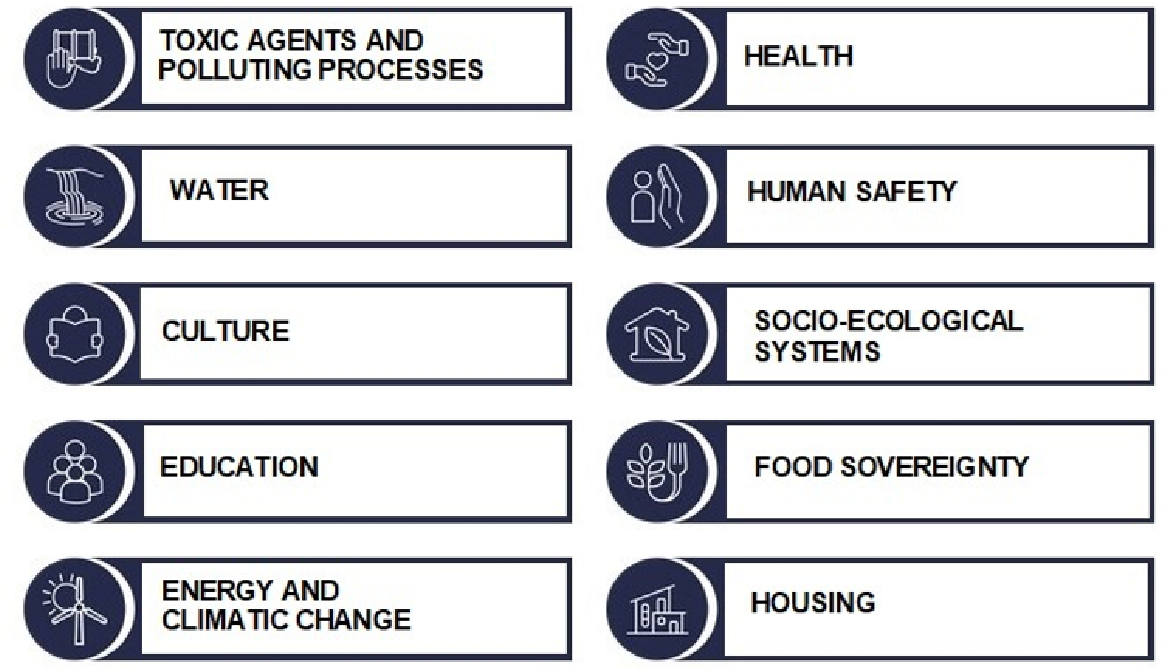
the population and the environment (Conahcyt 2023). This way, Conacyt defined ten Pronaces with a vision of bringing comprehensive
attention to strategic issues, considering theoretical-practical knowledge and seeking
a continuous dialogue to trigger inter and transdisciplinary research and high social
impact (Figure 1). These Pronaces include housing, the framework of the experience analyzed in this
work.
Figure 1:
The ten Conahcyt’s National Strategic Programs.
Source: Conahcyt (2023).
The guidelines established by the government implied submitting a proposal for a pilot
project to be conducted over three months; in case of a favorable response, we would
propose a more ambitious project of broader scope, called the National Research and
Impact Project (Pronai, in Spanish), to be carried out over three years. The pilot
project was given a favorable resolution to receive financing for its execution and
gave way to the formation of the work team, as described in the following section.
However, it did not make it to the next phase, which is suggestive to reflect on the
practical implications of projects of this type, in which a good number of sectors
of the country’s scientific and technological communities have not been involved.
Merida, Yucatan facing the housing problem
The municipality of Merida, capital of the state of Yucatan, located in the southeast
of the country, has an area of 854.41 km². It is a hybrid territory with an urban
and rural area, which, on one hand, has an urbanized center that starts from the foundational
area towards the outside, with a physical limit represented by the peripheral ring
road; and after this, there is a large extension to the north and south occupied by
47 rural or urban localities (Figure 2). The urban part is made up of neighborhoods and subdivisions, and the rural part
is made up of 12 police stations and 35 sub-commissaries.
Figure 2:
Geographic location of Merida’s priority attention zones.
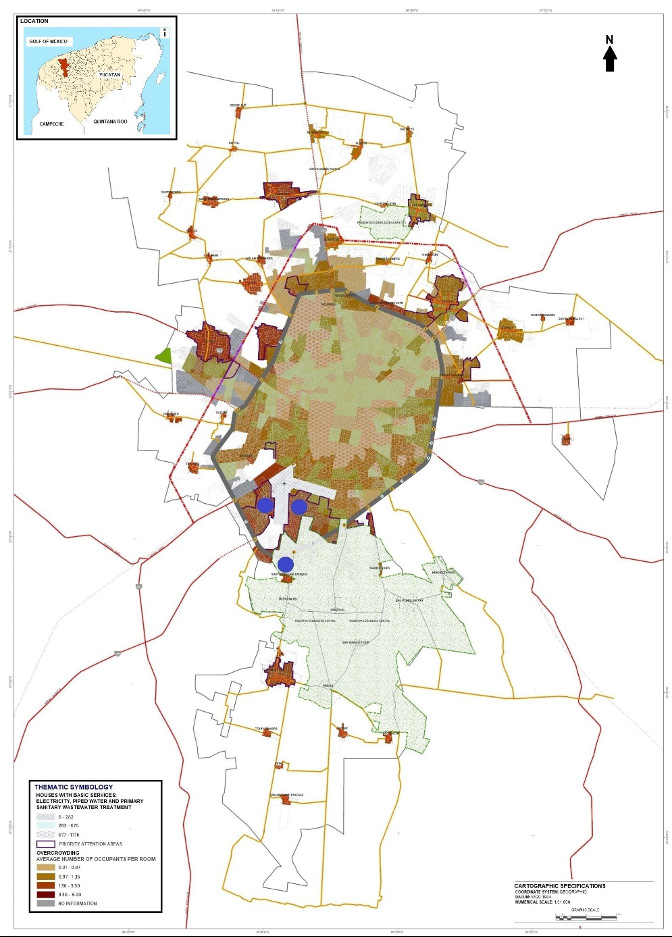
The purple circles indicate the areas inhabited by the groups of citizens to whom
participatory workshops were given (adapted from cartographic map).
Original source: Instituto Municipal de Planeación de Mérida (2023). Original information in Spanish.
The purple circles indicate the areas inhabited by the groups of citizens to whom
participatory workshops were given (adapted from cartographic map).
Mass housing construction, industrialized and unfocused on the concept of Decent Housing,
became an emerging activity to mitigate the crisis of the henequen industry starting
in the 1980s and became the main source of employment, to the extent that the construction
sector’s share in the state’s GDP surpassed the national average. As a consequence,
the percentage of urban population coming from rural areas increased notably from
that decade onwards, increasing the urban surface and the metropolitan area in the
municipality, where an important role was given to urban and real estate megaprojects
(Iracheta and Bolio 2012, 49-53). On the contrary, in the south, the low value of the land and the low interest of
construction entrepreneurs in acquiring and investing in it (in contrast to the land
in the north, northeast and northwest of the municipality), have led to a less aggressive
change of land use, but still present through some real estate developments.
Merida has been a city in constant dynamism and growth, which has been marked throughout
its history by “a dialectic of inclusion/exclusion that accentuates the social inequality
and spatial segregation inherited from the previous economic model, although with
new characteristics such as the accelerated privatization and fragmentation of the
metropolitan space” (Bolio 2014, 31-32). This phenomenon is explained by the neoliberal reforms imposed since the 1990s,
in particular, the Agrarian Law of the Salinas regime, which allowed the transfer
of large areas of periurban ejido land to private hands.
One of the most important problems faced by the low-income rural population is housing.
This need has been solved by living in small, affordable houses, generally located
in the southern periphery. The low sale or rental prices are one of the main reasons
that make the peripheral areas accessible to the low-income population. However, as
mentioned above, these homes do not have the minimum quality characteristics, so people
live in precarious, overcrowded and unsanitary conditions, as well as in urban insecurity
due to the lack of public services. According to the National Council for the Evaluation
of Social Development Policy (Coneval 2020), in 2018, 79.6% of the population of Yucatan lived in a situation of poverty or
vulnerability due to deprivation and income, which has a direct manifestation in the
lack of access to housing, which this Council considers among the factors of poverty
due to a lack of patrimony.
Opportunities for poor families to access housing are scarce because they currently
have no access to traditional sources of financing, since they do not work in the
formal economy and generally have nothing to back them up in order to be considered
creditworthy with banks. In fact, their only hope of improving the conditions in which
they live is that the government will transfer to them, through social programs, a
minimum resource to improve the quality of their housing; for example, through access
to land and/or construction materials. However, social housing is one of the areas
with the highest rates of backwardness in this region, since the current housing policy,
which withdrew subsidies, has reduced the possibilities of access to housing for thousands
of families in vulnerable conditions (Montañez 2021).
This social problem is compounded by the environmental impact of the aggressive and
vertiginous growth of the city, especially through real estate megaprojects, causing
heat islands in the city, which with climate change are gradually increasing temperatures,
which have been intensifying in the peripheral houses of the city (Villanueva-Solís and Torres 2023). Another worrying situation is the lack of drainage in the Yucatan peninsula, which
means that dirty water drains directly into the subsoil, contributing to the contamination
of the peninsula’s aquifer, the only source of fresh water supply in the region (Febles-Patrón and Hoogesteijn 2008). One more aspect to mention is the high-energy expenditure in homes and establishments,
especially for the use of air conditioners, which leads to an electricity deficit
in the state of Yucatan (Alavez and García 2019).
Due to these problems, the Merida City Council defined the south of the municipality
inside the peripheral ring as a priority attention zone (see figure 6), because it
is where the populations of lower economic resources are settled and where the backwardness
regarding the minimum conditions of habitability and provision of equipment is greater.
In accordance with these guidelines, our research group chose this southern zone,
in order to contribute with the proposal to improve the living conditions of this
sector of the population, with a perspective of environmental sustainability, as will
be detailed below.
The sustainable housing research group: challenges facing the complexity of inter
and transdisciplinary dialogue
The research-impact group created to address the Housing and Habitat Pronaces brought
together different fields of specialty and academic and life experiences. The initial
academic core had shared a previous project coordinated by the Center for Scientific
Research of Yucatan (CICY inn Spanish) between 2008 and 2012, entitled “Development
of a self-sustainable ecological housing” financed by the Conacyt-Government of the
State of Yucatan Mixed Fund. In the group of this new project specialists from CICY’s
materials area were included, with PhDs in chemical engineering sciences and polymeric
materials, and a master’s degree in communication with experience in science policy
and regional development; from the Autonomous University of Yucatan (UADY in Spanish),
two PhDs participated, one in engineering and the other in architecture; from the
National School of Higher Studies (ENES UNAM Mérida, in Spanish), a researcher in
public policy and a master’s degree in architecture, with experience in social planning,
citizen participation and participatory design of public spaces. From the government
side, officials from the Housing Institute of the State of Yucatan (IVEY, in Spanish),
specialists in urban development and planning, as well as liaison personnel from the
Municipality of Merida for liaison with social organizations and community groups
collaborated. From the civil associations, people with experience in community work
and work in urban areas were involved.
The purpose for each member was to contribute to the project development from interdisciplinary
and transdisciplinary perspectives while seeking to generate a pilot Participatory
Action Research (PAR) that emphasized in the exchange knowledge methodology with the
population involved in the problems addressed. The participants included academic
organizations, municipal and state government agencies, grassroots social organizations
and communities in the study area.
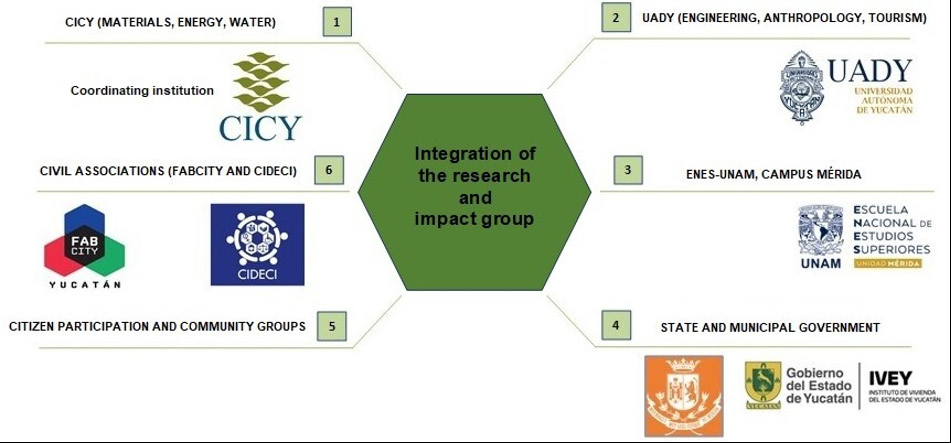
From an institutional perspective, the group was composed by specialists from the
following institutions: Centro de Investigación Científica de Yucatán, A. C. (Center
for Scientific Research of Yucatan; CICY in Spanish, the project applicant and coordinator)
through several research units: Materials, Renewable Energy, Water Sciences and Research
Directorate; Faculty of Engineering and Faculty of Anthropological Sciences, Universidad
Autónoma de Yucatán (Autonomous University of Yucatan, UADY in Spanish); Escuela Nacional
de Estudios Superiores (National School of Higher Studies), Campus Mérida (ENES-UNAM
Mérida, in Spanish); Instituto de Vivienda del Estado de Yucatán (Housing Institute
of the State of Yucatan; IVEY); City of Merida (Directorate of Social Development);
social organizations such as Fab City Yucatán A.C. and CIDECI, A.C.; as well as the
follo- wing Citizen Participation Councils and Community Groups in Merida, Yucatan:
two groups from Colonia Emiliano Zapata Sur 3, a group from Emiliano Zapata Sur 1
and 2; a group from Colonia San Antonio Xluch; and the Community Groups of San Luis
Sur Dzununcán and San Juan Bautista. Figure 3 outlines the integration of the research and impact group.
Figure 3:
PRONAI Research and Advocacy Group.
Source: Cruz et al. (2022). Original information in Spanish.
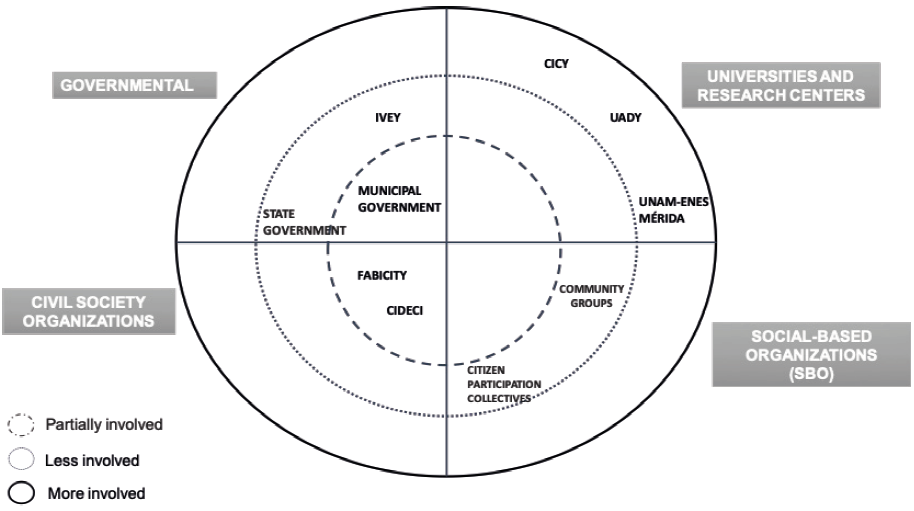
It is important to mention, according to the map of actors (Figure 4), that the degrees of participation and collaboration in the research collective
were different for each sector, which we classified into four groups, namely: 1) governmental,
2) universities and research centers, 3) civil society organizations and 4) social-based
organizations. As can be seen in Figure 4, academic institutions had a higher degree of involvement, secondly, the state government,
through IVEY, as well as social-based organizations and to a lesser extent civil organizations.
This reflects the difficulties of maintaining the commitment and collaboration in
research projects by non-academic actors, since they do not constitute a priority
for them, implying other types of motivations that sometimes is not possible to attend
to in the expected times, given that scientific and technological processes have other
time horizons. Even these transdisciplinary processes achieve better results when
they arise from the initiative of social and productive actors.
Figure 4:
Map of actors. Pronai Advocacy Research Collective.
Source: Cruz et al. (2022). Original information in Spanish.
In this experience, and according to the Conahcyt guidelines, the multidisciplinary
group was integrated to tackle the problems of interest through a comprehensive approach.
The group was made up of 11 members of the advocacy project and 50 participants from
the community groups. However, it is worth mentioning the project development constraints
that emerged from the shift in government policy since neither training nor all the
tools were available to address several aspects required to articulate the project.
This is because this approach transitions from a scheme of basic research proposals
to one of applied research, emphasizing the social “impact”; however, several terminologies
remained undefined from the calls. The following are some controversial aspects at
the time of Pronai project submissions:
-
General research and impact strategy (pilot experiences).
-
Active dissemination strategy.
-
Methods for the inclusion and integration of knowledge and practices by stages.
-
Proposal of internal mechanisms for reflection, recovery, development of practices,
and progressive coordination improvement of all workgroup members.
-
Team performance assessment criteria and indicators.
-
General guidelines for the national propagation strategy (active dissemination).
-
Research-impact group performance.
This undoubtedly reveals a complexity from the postulation of the proposal and the
possibilities of fulfilling these expectations embodied in the scientific policy instruments.
However, the integration of the group itself also presented complexities, such as
the lack of a common understanding of different notions, for example, the concept
of social vulnerability, PPI or industry 4.0 and circular economy. The latter terms,
for example, were suggested by the proposal evaluation group to be included as an
important part of the overall project formulation. Another problematic situation was
the different interests and values of each of the stakeholder groups that interacted
in the project and the implications of this (in relation to time availability, resources,
differentiated objectives and degrees of commitment). The integration of theoretical
and methodological notions was addressed with seminars to establish an integrated
framework around the topics listed above, such as social vulnerability, public policies
and governance. We also worked on topics such as circular economy and industry 4.0,
as well as action research methodologies based on PRA.
Another problematic situation was the different interests and values of each of the
groups of actors that interacted in the project and the implications of this (in relation
to the availability of time, resources, differentiated objectives and degrees of commitment).
Integrating diverse actors, in order to comply with a requirement of the call, such
as social actors or civil association-type groups, implies an enormous challenge of
involvement in the project so that their involvement is not only on paper, but so
that they can really join the dynamics of the working group in an active participation.
This represented a complexity factor to achieve the same level of cooperation among
the different actors. Given that the scientific dynamic has traditionally been to
form work teams between academic peers, opening these spaces to other non-scientific
actors represent important changes in the way work, scope and responsibilities are
shared.
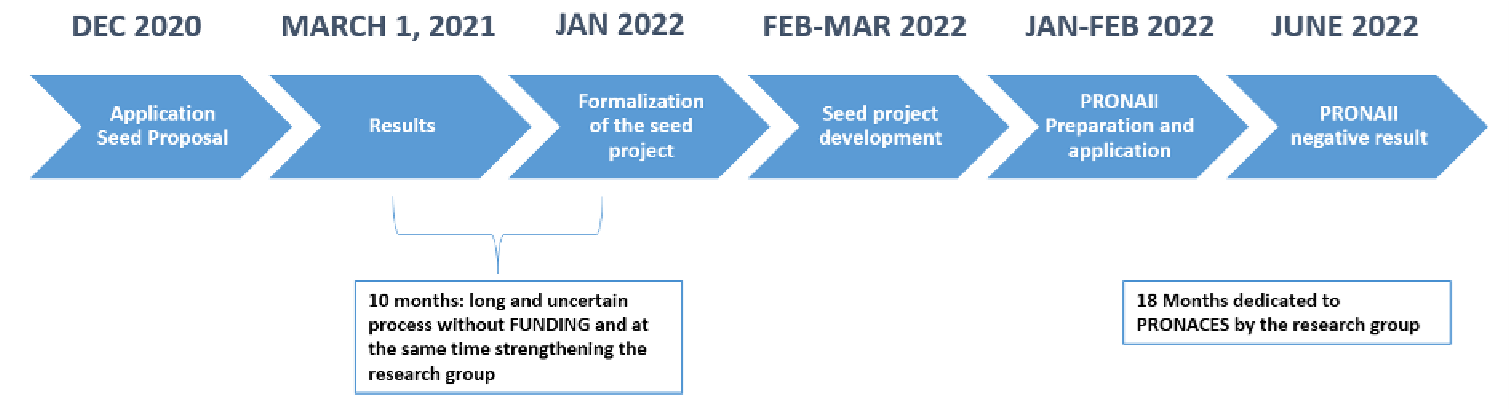
It should be noted that the time allocated for the development of the first phase
of the project (seed project) was only two months. However, the total time from the
formation of the team and the application to this first stage until the PRONAII result
was obtained, was a year and a half, as shown in Figure 5. Establishing an inter and transdisciplinary framework in the time allocated for
this first phase entailed an important effort of openness among the members, to establish
a dialogue between the basic sciences and technologies, and the social sciences. In
addition, the long time between the application of the first phase of the project
(seed project), which took almost a year, generated great uncertainty. Nevertheless,
the integrated collective decided to continue working even without certainty given
the commitment established with the communities and neighborhood groups.
Figure 5:
Timeline in the development of the project.
Source: Own elaboration.
However, the most significant and challenging aspect of transdisciplinary work was
the interaction with the communities of marginal urban zones since many academic researchers
usually work in experimental laboratories following a monodisciplinary approach. Moving
to the social laboratory and applying social methodologies as PAR, implies training
and expertise in other methodologies, as well as a social sensitivity not commonly
experienced in hard disciplines. This involved engaging and bonding with new team
members (academics and fellows) who were better acquainted with these inter and transdisciplinary
work fields. Another constraint was the time available for community group members,
since most were women and mothers who alternated between housework, childcare and
participation in these collective activities.
A final complexity was the excessively long time taken for Conahcyt to provide us
with information on the correct and timely execution of the pilot project. Almost
one year passed between the initial pilot project approval date and the Pronai project
submission, during which, the group had minimal feedback from Conahcyt and, to add
more complications, there were no financial resources provided by the government.
Under these circumstances, keeping a united research group focused on participating
in the project was difficult. However, the project leader and the group members showed
their commitment despite the lack of funding certainty. During those months, internal
seminars were held and progress was made in the participatory analysis of the housing
conditions by interacting with community groups. All this led to greater integration
of the research group and to acquiring new learnings as a team.
Experience from the interaction between academic and community groups
Within the Participatory Action Research (PAR) methodological framework applied in
the project, participatory workshops took place with community groups in southern
Merida, where these groups live in priority attention areas as defined by the Instituto Municipal de Planeación de Mérida (2023) (Municipal Planning Institute of Merida) and as we indicated above, where housing
is most precarious, including overcrowding and limited access to basic services. The
location of the areas to carry out the pilot experiences was made based on the review
and analysis of the information contained in plans of the city of Merida such as the
one in Figure 2, showing the priority attention zones defined by the Municipal Planning Institute
(Implan). These areas are those surrounding the city’s airport (the areas of Los Robles,
San Marcos Nocoh, San Antonio Xluch I, II and III, and the neighborhoods of Dzununcan).
It was decided to also work in areas located outside the peripheral ring (Figure 2), given that they also present a significant number of actions requested to address/support
housing needs, information that was provided by IVEY.
Workshops were delivered following the IAP methodology mentioned above. The aim was
to motivate householders to get involved and contribute, sharing to proposed solutions,
the issues related to their houses from their own needs, wishes and experiences with
the support of specialists from various fields.
The first contact with the selected communities consisted of an introductory workshop
held with representatives of citizen councils in the study areas, supported by the
Department of Citizen Participation of the Directorate of Social Development, Municipality
of Merida, who allowed us to use their facilities in Integral Development Centers
located near the selected communities during the workshops (Figure 3). To this end, its promoters assisted us in inviting the leaders of each neighborhood
and other interested people to participate. Citizen Councils are composed of neighborhood
citizens who meet regularly (weekly or monthly) to discuss community issues and manage
improvements with the authorities. Promoters act as liaisons between Citizen Councils
and the City of Merida.
Subsequently, participatory workshops were held to gather data on the urban environment
and housing needs. Table 1 summarizes the activities carried out in each workshop. The aim was that the results
of these workshops would contribute, both to the design of sustainable housing as
well as to the decision making process regarding the training of these communities
for the possible self-production of housing in case the Pronai project was approved,
focusing on their areas of opportunity, on an analysis of their activities and the
real characteristics of the houses. As of the writing of this document, this phase
has not started, as the full proposal was not considered by Conahcyt and is dependent
on external funding sources for its continuation.
Table 1:
Summary of the participatory workshops delivered.
|
Workshop
|
Date and place
|
Addressed to
|
Description
|
Target
|
|
1. Workshop for approaching and presenting the work project to representatives of
citizens’ councils.
|
-
Emiliano Zapata Sur, February 17, 2022.
-
Crescencio Rejón, March 16, 2022.
|
Members of Citizen Councils of the southern zone of the city of Merida.
|
-
1. Application of a survey regarding their homes.
-
2. Presentation of the Project and the work team.
-
3. Recommendations of the councils, for the application of the following workshops.
|
Workshop, presentation to the community and planning of future workshops.
|
|
2. Participatory workshop to diagnose the urban environment
|
Emiliano Zapata Sur, May 9, 2022.
|
Members of Citizen Councils in the southern area of the city of Merida.
|
-
1. Application of a survey regarding their homes.
-
2. Mapping of transportation routes and opportunity zones in your community. Analysis
of existing infrastructure and equipment.
-
3. Writing about the historical line of your community and housing.
-
4. Drawing by children about their housing and environment.
|
Gather updated information from the perspective of the residents regarding the urban
environment and the background of their community.
|
|
3. Participatory workshop to diagnose housing needs
|
CDI Emiliano Zapata Sur, May 13, 2022.
|
Members of Citizen Councils of the southern zone of the city of Merida.
|
-
1. Drawing up a floor plan of your home and analyzing your activities.
-
2. Analysis of strengths and weaknesses of your home.
-
3. Description of your desired home.
|
Collect information regarding their housing needs, for subsequent design and implementation
of training and participatory workshops on selfconstruction.
|
Between the three workshops held, about 67 people participated and, particularly in
the third workshop, there was an important presence of children. During the participatory
workshops, surveys were applied to citizen representatives about the characteristics
of their homes and various activities were implemented, based on participatory methodologies
for habitat design, such as the mapping of community needs, the history of the community,
“judging your home” or “drawing my ideal home”, which, adapted to the case, were based
on the Living- stone methodology for participatory housing design (UN Habitat 1996).
It is worth mentioning that 99% of the representatives who attended the workshops
were women, between 30 and 60 years of age, and more than 70% were housewives and
mothers, who expressed their gender perspective in their list of needs. At their request,
a space was created for children, who, through drawing activities, also considered
their vision of the place where they live. A very relevant aspect that stands out
in the observations of the workshops is that they are very well organized and perceive
their neighborhoods or their blocks as safe, but not the place across the street.
There is an expression of belonging and self-care.
The set of experiences, in which methodologies with diverse characteristics were applied
and developed, made it possible to generate an improved version of the advocacy model,
which, in principle, can be adapted in a differentiated manner to the particular conditions
of different communities in which social problems associated with habitat and housing,
particularly overcrowding, are present.
It was noted as an important aspect, to give continuity to the activities that include
the training of the community about productive processes of materials and housing
construction processes, as well as to follow up on the workshops and evaluate the
results in greater depth. The type of activities to be carried out will depend on
the results of the analysis of the workshops conducted in this project, regarding
the social reality of the selected community. A series of coordinated actions should
be implemented to further involve the different sectors involved in the housing and
habitat problem through public dissemination and communication activities that promote
the positioning of the topic, which will facilitate the processes of social appropriation
to contribute to universal access to knowledge.
The dynamics with the communities showed their full willingness to participate, which
shows a potential to be explored in future projects of this nature. It is worth mentioning
that, as a result of this initiative and not obtaining Pronai funding, CICY promoted
its own project to continue the advocacy work with social groups called “Elaboration
of a diagnosis to increase the habitability and durability of housing for the vulnerable
population of Merida, Yucatan” (Rivas et al. 2023), in order to encourage more participation of the target population in the development
of designs that would take advantage of the large spaces that usually have the houses,
to use them for more vegetation, as well as for their learning in the elaboration
of fibro-reinforced concrete and evaluation of different alternative materials in
their housing. The approach with the neighborhood groups, in short, made it possible
to initiate this process of exchange among the social group in order to establish
a dialogue of knowledge and initiate the actions of social retribution of knowledge
that will make it possible to build true transdisciplinary work in the future.
Conclusions
The transition from monodiscipline to inter and transdiscipline, coupled with the
construction of common analytical frameworks, has become a central challenge for academic
research to advance in solving complex social and environmental problems. To this
end, it is necessary to be open to other frameworks and approaches to reality, as
well as to interact with other types of relevant and, at the same time, socially robust
knowledge. On the one hand, interactions shall promote dialogue between different
areas of knowledge, both academic and nonacademic; on the other, it shall encourage
the articulation of knowledge with society to face the current socio-environmental
crisis.
An important factor, undoubtedly, was the effort to integrate the project in its entirety.
However, the fact that it was not approved by the funding agency meant that the collective
and the communities invested some time in an unfinished process, approximately two
years of work from the beginning of the process. This could lead to the creation of
false expectations due to the gap between academic times and the times of other social
actors, although it also led to the construction of lessons learned in the advocacy
collective.
The difficulty of assuming the challenges that this project implied for a research
center that by its nature only has researchers in the area of basic and natural sciences,
can be seen as a difficulty, but also as an opportunity to open up to participate
with other institutions with training in social sciences, and even the possibility
of integrating students from different degrees and participate through experience
in the formation of human resources.
The transformation in the current Mexican government regarding scientific and technological
policy has led to significant challenges in academic communities since it forces a
reconfiguration in the roles and characteristics of research groups, as well as in
the methodologies adopted and the objectives pursued, which are to be reoriented towards
social impact. Although this is a beneficial scope, it should not be the only framework
promoted to generate new knowledge. Moreover, in practice, it involves major challenges
in the organization of science that cannot be established overnight; instead, it is
a mid to long-term process that requires a formative evolution to achieve greater
openness to dialogue between specialists from different disciplines and with bearers
of non-scientific knowledge; the latter implies that researchers and scientific institutions
should generate new strategies for linking with social groups. These new scientific
forms and dynamics therefore imply a gradual learning process, but in this case it
was carried out under urgent conditions to meet the requirements set by the federal
government.
The experience discussed in this paper highlighted the need to improve methodologies
to interact with communities facing social and environmental issues associated with
habitat and housing, particularly under overcrowded and social marginalization conditions.
One of the lessons learned is that replicating these processes in other experiences
is unfeasible if they are not first customized to the particular conditions of each
community so that they are effective in the joint production of knowledge and, above
all, in the implementation of solutions to problems identified collectively. Considering
the cultural context and the timing, needs and degrees of commitment in these initiatives
led by academic communities is essential to place the gender perspective and children,
key actors in the participatory processes, at the center of the interactions.
On the scientific sector, working with community groups and governmental and civil
actors also imply greater effort and commitment. In particular, the Sustainable Housing
research group should continue carrying out activities such as training the community
about material production and housing construction processes, as well as follow-up
and evaluation of results. Finally, improving the planning and execution of coordinated
work strategies is essential to further engage the different sectors involved in housing
and habitat issues. ID