Introduction
Mexico is one of the few countries that combine enormous fishing and agricultural
legacies. It is one of the top 20 nations worldwide in terms of coastline (11,600
km), inland waters (2,500,000 ha), exclusive economic zone (3,000,000 km2) and fishing activity. Its fishing sector incorporates 69,000 small-scale fishers
and 8,000 offshore or large-scale fleet fishers (88% men and 12% women). Small-scale
fisheries commercially capture approximately 665 species, while the offshore fishery
is dedicated to the capture of 48 species (Conapesca 2018). It is estimated that approximately one million families in Mexico are formally
or informally employed in pre and post-capture processes, with an increased participation
of women during the initial and final stages of the commercial cycle (Ibid ). Furthermore, Mexico is also one of the eight great centers of origin, domestication
and diversification of plants (Harlan 1971). Close to 200 species of edible crops of great global food importance have their
epicenter in Mexico (Casas et al. 2007). Currently, Mexican small-scale farmers are grouped into around 32,000 agrarian
communities distributed in all the states of the country and covering around 90% of
the municipalities nationwide, forming a sector of approximately six million families
(Morett-Sánchez and Cosío-Ruiz 2017). Of the entire Mexican small-scale agriculture sector, 80% is represented by rural
subsistence units with market linkages (FAO 2020). Despite this valuable fishing and agricultural legacy, Mexico is currently subsumed
in a deep food and malnutrition crisis. According to the National Council for the
Evaluation of Social Development Policy (Coneval, by its Spanish acronym), 55% of
Mexican households present some manifestation of food insecurity, while 24% of the
national population live under conditions of food poverty and 12% of the rural areas
experience chronic malnutrition, including one million children (Coneval 2022). Of the national population living in food poverty, 70% are indigenous people, while
one in four children with chronic malnutrition are indigenous (Ensanut 2018).
In order to analyze the paradoxical and complex food reality of Mexico, our study
centers on the food regime approach. Coined by Friedmann and McMichael (1989), this approach allows us to analyze, from the theoretical bases of the political
economy, the modern world-system and center-periphery, the dynamics and structuring
of the rules and devices that govern the production, distribution and consumption
of food on a global scale. Such rules and devices have been adjusted historically,
and it is therefore possible to recognize different stages within the global food
regime: the colonial, agro-industrial, supermarket revolution, and an ultimate stage
of financial speculation and ‘green’ or ‘blue’ dispossessions (McMichael 2009).
In Mexico, people are subordinated to (neo)colonial trade logics in which we export
quality food while importing second-rate products. For instance, we export finfish,
mollusks and crustaceans to countries with high commercial standards such as the United
States, Japan and Spain, and import fish fillets, among others, of frozen ‘basa’ from China and Vietnam (Conapesca 2018). Despite ranging around the top 15 countries worldwide in fish catch, Mexico’s annual
per capita consumption of fish and seafood ranges around 13 kg, a value well below counterpart
countries in terms of fisheries such as Japan, China, Norway, Portugal and Spain with
values of 40 to 65 kg (Ensanut 2018).
Mexico also imports agricultural products comprising more than half of that consumed
nationally, including maize and beans, the basis of the people’s diet, in exchange
for elite exports such as avocado (Appendini 2014). Moreover, the agro-industrial regime has led to high dependence on chemical inputs
in order to produce food. In this regard, around 80% of small agricultural production
units in Mexico use at least one technology of the “Green Revolution” (Altieri et al. 2021). Another negative impact on small-scale producers has been the irruption of large
national and transnational supermarket chains because, given their capacity for commercial
monopolization of production, urban, peri-urban and rural consumers have turned to
these spaces to satisfy a large part of their food requirements, not only for ultra-processed
products, but also for fish, seafood and foods of agricultural origin (Schwentesius and Gómez 2008). Finally, to understand the small-scale producers’ exclusion process, the national
susceptibility to food speculation and the increase in corporate agricultural frontiers
due to the lack of price stabilization and regulation mechanisms must be considered,
as well as the neglected regulation of agrarian and coastal dispossessions (Robles-Berlanga 2012).
The historical turning point from which the dynamics described began to be exacerbated
was the neoliberal dawn of the 1970s and the implementation of the North American
Free Trade Agreement (NAFTA) in 1994. Since then, Mexico has experienced what several
authors have described as the disarticulation of national fisheries and agriculture
(Calva 2019, 615), and the consequent development of food dependence (Barkin 1987). In the initial stages of neoliberalism in Mexico, fishing cooperatives (Cisneros-Mata et al. 2023) and farming organizations were dismantled, as well as effective state participation
in popular food supply (Yúñez-Naude 2003). Thus, for small-scale fishing and farmer families, as well as for marginalized
urban and peri-urban households, since NAFTA began (Gálvez 2018), there has been a strong tendency towards food insecurity and the double nutritional
burden syndrome: the coexistence of overweightness and malnutrition (Varela-Silva et al. 2012). In farming households, protein deficits have been documented; in fishing households,
there are dyslipidemia risks due to lack of eating habits that involve fruits, vegetables
and cereals. This can be added to the fact that the diets of both groups share with
those of poor urban and peri-urban households a high consumption of ultra-processed
foods typical of the widespread ‘westernization’ of the Mexican diet (Popkin 1999).
Despite progressive discourse in the national public realm, following the recent transition
of power from ‘pro-neoliberal’ to a ‘leftist’ government, policies for reducing public
spending and the dynamics of dismantling the fishing and agricultural means of production
have continued. As antagonistic as it may seem, the neoliberal paradox of post-neoliberal
governments can be understood from the reasoning of neoliberalism as a structuring
process and not only as a political ideology. Therefore, beyond changes in political
representativeness, the factual powers continue to reproduce themselves (Fletcher 2019): “neoliberalism, so long, we hardly knew you” (Keil 2009, 231). The fisheries sector has been one of the most affected by the leftist government:
22 of the 23 federal fisheries support programs have disappeared under the current
administration (Cisneros-Mata et al. 2023). It is noteworthy that the budget for inspection and surveillance activities has
almost disappeared, even though approximately 60% of the fish catch in Mexico is extracted
without fishing permits, using irregular fishing gear, during closed fishing seasons
or even illegally within marine protected areas. On the other hand, greater public
efforts have been channeled into the agricultural sector led by the Ministry of Agriculture
and Rural Development (SADER, by its Spanish acronym) where two antagonistic forces
dispute its focus between the agroindustry and peasant-agroecology (Bazán Landeros and Torres-Mazuera 2021).
Regarding small-scale producers’ leadership, over the last four decades, a large majority
of the fishing and farming organizations in Mexico have concentrated their power in
old leaderships and have attended more to programs of political opportunism than to
movements of social struggle (Carton de Grammont 2008). For instance, Mexican fishing and farmer organizations present very limited participation
in international social movements of great importance in other Latin American contexts,
such as the World Forum of Fisher Peoples and La Via Campesina.
Given this complex national panorama, in this paper we pose the following research
question: how, in the face of the exclusion processes of the current food regime,
abandonment of public policies and erosion of most of the sectoral organizational
capacities in Mexico, can small-scale fishers and farmers, and urban and rural consumers
be articulated in order to improve their productive, commercial, food and nutrition
problems within their living contexts? Thus, the aim of the study is to outline a
theoretical-methodological proposal, based on our experience and that of colleagues
with decades of research in fishing and farming territories, in order to provide the
scaffolding for the transdisciplinary articulation of complementary and alternative
territorial circuits of production-distribution-consumption that connect coastal areas,
the rural inland and small-medium cities on a micro or meso-regional scale, from which
food systems can be relocated without compromising the fishing and agricultural resource
base. In such articulation, collaboration between fishing and farmers’ families and
organizations themselves, as well as NGOs, academics and government are of utmost
importance, which has a high potential to occur given the previous collaborative networks
that already exist in many Mexican territories (e.g., Herrera and Guerrero-Jiménez 2020; Bello-Baltazar et al. 2020). It will also be of utmost relevance to find mechanisms for the participation of
a whole critical mass of reflexive consumers, capable of demanding fairer forms of
food commercialization, such as nested markets (Van der Ploeg et al. 2022).
The article is structured in six sections. After this introduction, the second part
describes the transdisciplinary methodological approach, and the third part introduces
the Yucatan Peninsula (YP) as a case study, describing the problems currently faced
by its small-scale fishers and farmers. The fourth part analyzes the type of results
that could be obtained of the proposed approach, while fifth section focuses on discussing
challenges and limitations of the proposal. The final part contains concluding remarks
considering the scope of this proposal in terms of its application to other related
contexts in Mexico and in Latin America.
The transdisciplinary approach
The whole research approach comprises a combination of theoretical concepts and analytical
frameworks, which have been developed over several decades, primarily by scholars
from Mexico and other regions of Latin America, although we also incorporate some
reflections of international scope, such as the study of food regimes and transdisciplinary
discussions. In particular, the development of the study benefited from our participation
in the following five specific academic-social-political interface experiences: 1)
the organization of the international seminar “Dialogues for the construction of agri-food
sovereignty and security in Mexico” held in 2020, in which a group of 60 academics,
government officials and leaders of national and international organizations debated
the productive and food paths of the country (https://www.iis.unam.mx/soberania-agroalimentaria/); 2) publication of the book Socio-environmental regimes and local visions: transdisciplinary experiences in Latin
America, which provides a transdisciplinary framework to address different socio-environmental
regimes using case studies from seven Latin American countries (Arce-Ibarra et al. 2020); 3) our collaborative work in multidisciplinary groups or research and influence
teams (RIT) involving the development of two project proposals, namely “Artisanal
fishing and food sovereignty: innovation niches to promote consumption and expand
the distribution of fishery products in the Yucatan Peninsula” and “Popular and solidary
agri-food trade corridor between milpera and Puuc regions in Yucatan” funded by the Mexican National Council of Science and Technology
(Conacyt, most recently Conahcyt, by its Spanish acronym), to address national issues
using an integrated approach to innovation and influence; 4) our experience participating
in platforms, networks and social movements related to fisheries and agriculture,
including the Community Conservation Research Network (CCRN, https://www.communityconservation.net/), the Too Big To Ignore: Global Partnership for Small-Scale Fisheries Research (http://toobigtoignore.net/), and the technical team of La Via Campesina North America; and finally, 5) our collaborative field work, conducted over a period
of almost three decades, with fishing and farming communities of the YP, which leads
us to empirically illustrate the proposed approach for this specific regional context.
Leveling the common theoretical ground
Our methodology is based on what we have called the transdisciplinary approach to
research and influence (TARI). In Mexico, from 2019 to date, Conacyt (Conahcyt) has
promoted influence or social transformation as part of research projects that seek
to solve the country’s most pressing problems, including the quest for and promotion
of national food sovereignty. In particular, the idea of ‘influence’ implies promoting
the improvements, change or social transformation required to partially or totally
solve the addressed research problems (García-Barrios 2019).
Thus, a TARI begins with the formation of a multidisciplinary working group called
the research and influence team (RIT), which is responsible for the entire process
of the research project. Based on interpellation with the subjects and social realities
of the study area, the RIT seeks to move the research process towards a transdisciplinary
realm. The RIT is generally composed of experts with different specialties. By working
and interacting within a RIT, participants should recognize that they work “in dialogue
with the different” (Merçon et al. 2021, 199). Some operational ground rules of collaboration are that, in general, the RIT does
not work in a top-down manner guided by any leader, but rather the participants work
horizontally, with leadership that is most often rotated, promoting empathy and an
openness to be able to teach, and learn from, any of the people involved in the RIT
(see Chuenpagdee and Jentoft 2019; Bello-Baltazar et al. 2020). The main tasks of the RIT are: i) selection of a theoretical-conceptual framework
for the research; ii) analysis and discussion of the philosophical bases of the type
of transdisciplinarity that the study will employ; iii) identification of the research
and influence problem to be addressed, as well as selection of the study area; and,
iv) carrying out the required fieldwork, analysis of the results, and socialization
of the insights resulting from the research with the communities of the study area.
Regarding the conceptual framework for the research (although each RIT would choose
one that suits its conditions), here we propose the model of local socio-environmental
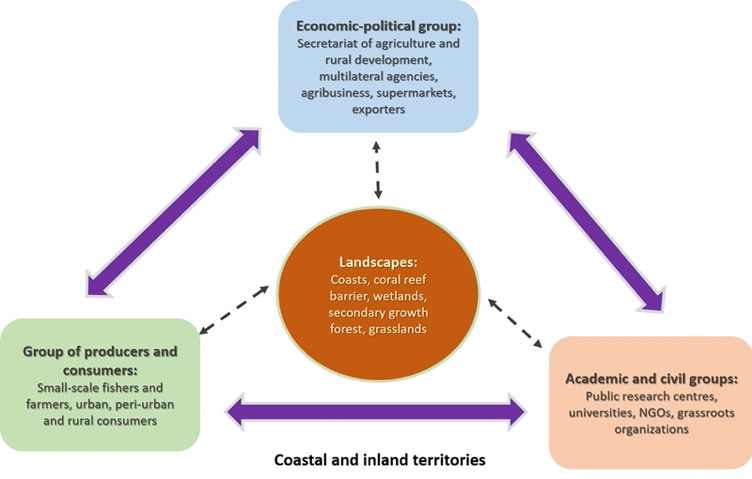
systems (LSES) as a basis for reflection (Parra-Vázquez et al. 2020) (Figure 1). The LSES portrayed in Figure 1 is a production system in which it is explicitly recognized that its functioning
has been conditioned for several decades by the rules imposed by the global multilevel
food regime. Under this premise, the possibility of small-scale producers maneuvering
to make major changes within the system is limited (Parra-Vázquez et al. 2020). A LSES refers to a complex small-scale production system, located in coastal-marine
(fishing) and/or terrestrial (agricultural) territories. Each production system uses
the landscape units contained in its territory as resource base or as inputs. Three
main human groups interact in each LSES: a) group of producers and consumers; b) the
socio-academic group, which can include people with various profiles, for example,
professionals, researchers and representatives of NGOs; and, c) the economic-political
group comprising government officials from the three levels of administration, as
well as middlemen and entrepreneurs (Figure 1).
Figure 1
The local socio-environmental system (LSES) model as a basis for reflection of our
methodological approach.
Source: Adapted from Parra-Vázquez et al. (2020).
With respect to the transdisciplinary philosophical bases that the research will use,
there are different positions and schools of thought offered by the literature, from
Piaget (1972) to the most recent reflections published for the Mexican and Latin American contexts
(Merçon et al. 2021). Since we recognize that each RIT must organize its own exercise for each territorial
context where any study is carried out, the following paragraphs only present some
reflections, which are basically related to our own conception of one, among other
possible transdisciplinary approaches.
Literature review reveals that there are different definitions of the words transdisciplinary
and transdisciplinarity. In reviewing their etymological origin, Basarab Nicolescu
reports that the prefix “trans” “is a Latin word meaning at the same time, in between,
across, and beyond.” (Volckmann 2007, 78). In other words, “Transdisciplinarity is completely different [to interdisciplinarity]
in the sense that it puts the problem of the information that circulates in between
disciplines, across disciplines, and even beyond any discipline” (Volckmann 2007, 77). Furthermore, Nicolescu postulates that transdisciplinarity is a context in which
it is recognized that there are “different levels of reality” (Volckmann 2007, 80) in different domains of the world.
Nicolescu’s proposal of different levels of reality also applies to domains of human
society. In this regard, we extend this idea to the formation and development of the
RIT: “There are levels in ourselves, in our own understanding, representation, languages
and so on, and even levels of reality of the Subject” (Volckmann 2007, 80). If this complexity of reality is recognized, then the contributions of each member
of the RIT require consideration and discussion that, most probably, ‘the different
ones’ in dialogue -including the communities in which the study is developed- will
collaborate from different levels of reality, as well as from different worldviews.
Other complementary views on transdisciplinarity indicate that it is the amalgamation
of scientific knowledge with social practices (Lang et al. 2012), which is context-specific and where power relations and interculturality generally
emerge (Zamora 2020; Bello-Baltazar et al. 2020). Several authors recognize transdisciplinarity as a relatively new concept (Choi and Pak 2006; Volckman 2007) one that can be conceived as a tool, but also as an intrinsically unfinished project
permanently under construction (Max-Neef 2005).
A practical component of transdisciplinary approaches
From our own experience, one of the practical components of a transdisciplinary approach
involves ‘how to integrate’ the parts of a whole (i.e., the story of the project,
from start to finish), and relates to moving from the multidisciplinary or additive
aspect of the research process, first to an interdisciplinary realm, and then to transdisciplinarity
(Arce-Ibarra et al. 2020). We have conducted this exercise by selecting and discussing key categories that
serve as the explicit axes, or ‘bridging’ concepts, used as threads that run transversally
through the research process (see Arce-Ibarra and Gastelú-Martínez 2007; Puc-Alcocer et al. 2019). To examine the exclusion processes of the global food regime, we have chosen the
concepts of ‘food regime’ (from political economy), ‘territorial production-consumption
circuit’ (from economic anthropology) and ‘territorial innovation niche’ (from ecology,
transitions literature, and political sociology), as the key interrelated concepts.
From these concepts, with the participation of the RIT and the beneficiary social
subjects of the study area, knowledge and influence can be created while weaving the
story of the study. We refer to a territorial production-consumption crcuit (TPCC),
also known in the literature as a value chain (Coronado et al. 2020), as the productive process in which the participating social subjects and their
interactions are analyzed, from obtaining the raw materials to consumption, through
processing, distribution and commercialization. A TPCC can be mapped, and its types
of interactions identified and analyzed, including the power relationships (Coronado et al. 2020). When it is considered necessary to make changes or modify a TPCC (for example,
to create more sales or consumption access points for certain users), it is necessary
for the social actors involved to analyze the process and identify innovation niches
to carry out the proposed modifications. According to Ingram (2015), an innovation niche is composed of sources of ideas and areas of opportunity that
generally become new practices and actions, which, being outside the status quo, represent a challenge to that which is already established, in this case, the global
food regime.
Regarding the epistemological bases for creating knowledge, and considering Nicolescu’s
levels of reality, we argue that it will most likely be impossible for the RIT to
subscribe to a single paradigm of knowledge. Instead, we propose using epistemological
pluralism (Miller et al. 2009) with elements of critical interculturality, since all the voices of the social subjects
in the area of influence must be included (McDonell 2000; Zamora 2020). We refer to epistemological pluralism, because there will be a common arena (e.g.,
those spaces of collaborative work) in which the encounter and incommensurability
of various ways of creating knowledge, from orthodox to emerging paradigms or sociologies
(e.g., De Sousa Santos 2009), will be allowed. This provides an opportunity to be inclusive and to consider the
diversity of ways of working of the different RIT members. However, for each way of
creating knowledge, each member (or subgroup) of the RIT will present seminars at
the working meetings, where they will show the benefits and criticisms of the particular
epistemological paradigm to which they subscribe. In addition, they must show: a)
how their paradigm considers (or excludes) the voices and worldviews of marginalized
groups -such as small-scale fishers, farmers and popular consumers; b) how they would
combine their results with the social and cultural practices of the territorial circuits
under study; and, c), how the paradigm they use contributes to the social transformation
required in the research and influence project (sensuGarcía-Barrios 2019).
Research methods
To carry out this type of study, we propose a combination of qualitative and quantitative
research methods, all forming part of the participatory action research (Park 1992). Qualitative methods refer to the use of ethnographic techniques, participant observation,
community meetings and workshops, focus groups, life stories, social network analysis,
social mapping, and the elaboration of photographic or video documentary memories
-all with the informed consent of the social subjects (Bernard 1995). Quantitative methods comprise parametric and nonparametric techniques (Ramsey and Schafer 2002). Likewise, we propose to consider a third conglomerate of heterodox methodological
and epistemic tools typical of complexity sciences (Rivera-Núñez et al. 2021) that seek to move from analysis to synthesis and to the integration and multi-actor
discussion of results. The methodological approaches include the companion modeling,
agent-based computational simulations and serious socio-ecological board games (García-Barrios et al. 2016; De La Cruz et al. 2023).
Lastly, as part of the participatory action research cycle, it is essential to systematize
research processes and influencing experiences (Jara Holliday 2012), as well as to generate explicit spaces for social learning (Reed et al. 2010). Social learning refers to a higher order of discernment in which the RIT can challenge
(or entrench) previous values, norms and beliefs in order to collectively deepen the
constraints and opportunities that presuppose the quests for transformation or territorial
niches of innovation within given socio-environmental regimes (Fazey 2010).
The Yucatan Peninsula as a case study
We selected the Yucatan Peninsula (YP) in order to illustrate the proposed transdisciplinary
approach. This region, comprising the three states of Campeche, Yucatan and Quintana
Roo, is in southeastern Mexico and has an area of 181,000 km² and a population of
almost 5 million inhabitants (Jouault et al. 2022). The YP is part of the ancestral territory of the Mayan people who settled in this
area at least 5000 years ago (Rivera-Núñez et al. 2020). In the 21st century, the Mayan culture is expressed in the YP, among other things, through the
use of Yucatec Mayan language, which is spoken by nearly one million people in nearly
one thousand rural and coastal communities in this area (Bello and Estrada Lugo 2011). The culture is also expressed through the practice of slash-and-burnt shifting
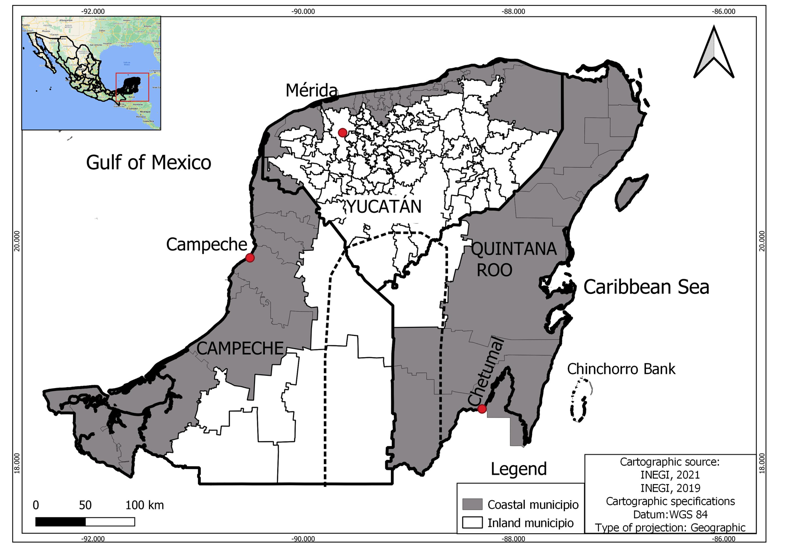
agriculture called milpa. It is estimated that approximately 50% of the population of the YP lives in coastal
communities (Coronado et al. 2020) and about 80% of the population occupying inland territories live less than 200
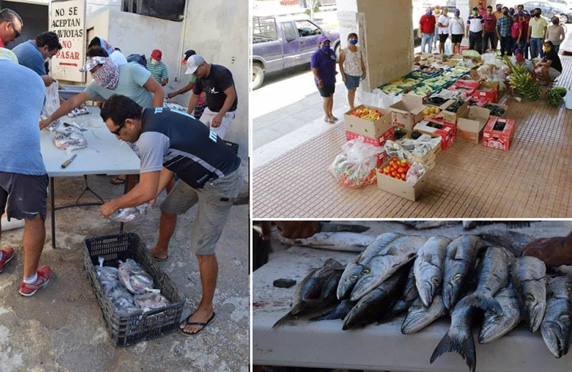
km from the coast (see Figure 2). However, except for periods of food constraint, such as those caused by the sanitary
contingencies of recent years, there is little exchange and trade between the fishing
and farming communities (Figure 3). The presence of these people and their traditions in the area implies that, when
this study is conducted therein, the RIT will encounter social actors with culturally
diverse local knowledge -from either the environmental, fishing or agriculturist realms.
It is with these people and their worldviews that the RIT is expecting to devise problem-solving
strategies related to their fishing and agricultural production and commercial systems.
Figure 2
Area of study for the transdisciplinary research approach. Coastal municipalities
are shaded and a zone of influence extending to 200 km in distance from the coast
is delimited in dotted lines.
Source: Produced by M. C. Saida Ochoa Huchin.
Figure 3
Solidarity exchanges of fish for fruits and vegetables among small-scale producers
of the coastal municipality of Dzilam de Bravo and the inland municipalities of Dzilam
González and Dzidzantún, Yucatan, during the COVID-19 pandemic in 2020.
Source: Alianza Peninsular para el Turismo Comunitario.
The research and influence problem
In general terms, despite the importance of primary sector activity in the YP, only
52% of the total population in Campeche, 60.3% in Yucatan and 65.1% in Quintana Roo
had achieved food security by 2018 (Coneval 2022). These values may vary depending on socio-environmental (e.g., presence of prolonged
droughts or hurricanes), socio-economic (high rates of migration of young people from
rural areas to urban and touristic areas) and political (presence of programs that
encourage production) factors.
In the last decade, YP’s fisheries operated with 675 semi-industrial fleet vessels
and 10,916 artisanal fleet boats. Considering both fleets, close to 27,000 individual
fishers were employed (Conapesca 2018; Coronado 2020). YP’s smallscale fishing systems are in coastal-marine areas where, depending on
the time of the year, closed seasons and the depth at which they are fished, fish,
elasmobranchs and invertebrates can be caught using a variety of fishing gear (such
as hand lines, fishing lines, gill nets, free or apnea diving, ‘hooka’ or compressor diving, and ‘jimba’, among others). Once the fishery product is caught, it is landed at the docks of
each community to continue through the network that makes up the territorial circuit
of distribution, marketing and consumption of fish and seafood (TPCC). Species of
higher economic value (such as octopus, lobster, or some fish such as grouper and
hogfish) are marketed either to the local tourist market or delivered to processing
plants, while medium and low value species are sold in the same locality and form
part of the domestic consumption in the households of the fishers themselves.
Despite the size and contribution of the sector to local, national and international
food systems, the literature reports (and the fishers themselves recognize) that the
coastal fishing sector faces several problems, including the fact that several species
are overexploited, and their catches are declining (Table 1) (Arreguín-Sánchez and Arcos-Huitrón 2011; Bravo-Zavala et al. 2022). Another striking problem is the difficulty of marketing medium and low economic
value products in regional and national markets (J.C.C.N. fisher from Telchac Puerto,
personal communication, October 2021).
Table 1
Vulnerabilities faced by small-scale fishers and farmers of the Yucatan Peninsula
within their territorial circuits of production-consumption, due to rules imposed
by the global food regime.
|
TPCC link
|
Key vulnerabilities
|
|
Artisanal fishers
|
Small-scale farmers
|
|
Extraction / Production
|
Overexploitation of resources; illegal fishing; lack of generational replacement;
blue dispossession.
|
Dependence on industrial inputs; soil depletion; low yields; production losses; lack
of generational replacement; green dispossession.
|
|
2. Storage
|
Lack of household and community infrastructure; catch losses due to the highly perishable
nature of the resources.
|
Lack of household and community infrastructure; loss of harvests.
|
|
3. Processing
|
Abandonment of food preservation and transformation processes for seafood products.
|
Low levels of the processing skills required for extending shelf life and adding value
to foodstuffs.
|
|
4. Distribution
|
Private monopolization of transport capacity at scale, imposing high freight rates;
relatively high export and concentration of marketing to the large regional tourism
sector; low direct sales to consumers and no public procurement of production.
|
Low transport capacity; high freight rates; lack of knowledge of market prices; voracious
coyotage and commercial concentration of production; few direct sales to consumers
and no public procurement of production.
|
|
5. Consumption
|
Generally low purchasing power; Westernized diets; relative loss of local gastronomy;
erosion of food reciprocity; lack of associative figures for social supply.
|
Low purchasing power; westernized diets; relative loss of local gastronomy; erosion
of food reciprocity; no associative figures for social supply.
|
|
6. Waste
|
Discarded catch; food waste; low capacities for utilization of special handling waste;
environmental contamination and sanitary problems.
|
Food waste; human and environmental contamination from chemical residues and burning
of agricultural waste.
|
The artisanal fishing sector has various distribution and marketing strategies for
species of high economic value (e.g., lobster and octopus), which are sold in several
tourist centers of the region (e.g., Cancun, Playa del Carmen), as well as exported
to markets in Europe, Asia and the United States (Coronado et al. 2020). However, products of medium and low economic value (several species of bony fish)
face market problems. There was a marketing crisis during the confinement periods
of the coronavirus pandemic, from March to July 2020 (Cobi 2020). On the other hand, the fishers have few strategies to market their lower value
catches to non-coastal rural communities, where the diet of middle and low-income
people includes almost no fish (Becerril 2013). In this sense, the problem of commercialization and markets for fish products also
negatively affects the equitable distribution of the food and nutritional benefits
of fish (sensuAlcocer-Flores 2015) among the regional population, particularly those suffering from health and nutrition
problems, which are largely those of middle and low income.
On the other hand, the agricultural systems of the Mayan farmer’s communities in the
YP revolve around four central production units: the milpa, the forest, home gardens and cash-crop plots. Particularly in communities that continue
to practice agriculture with traditional features, planting of the milpa is combined with the harvesting of the forests based on an agroforestry-type management
scheme. Home gardens are backyard areas surrounding Maya houses that contain cultivated
plants, animals and infrastructure are worked by the families themselves. Therefore
they represent multifunctional agroecosystems of agricultural, forestry and livestock.
Finally, in addition to the millenary agroforestry systems described above, government
programs in several rural regions of the YP from the 1960s and 1970s onwards promoted
irrigation production schemes for the commercialization of around 60 fruit and vegetable
species in regional tourist, national and international markets (Lazos et al. 2022).
The main problems of the agricultural sector are productive, commercial, and food,
which encompasses six main links of the TPCC circuit (Table 1). Above all, since the 1980s and 1990s, under public programs for the modernization
of rural Mexico, milpa agriculture began to undergo a process of simplification due to increasing use of
agro-industrial inputs. The simplification of the milpa has reached the extremes of hybrid maize monoculture (or bicultivation with beans)
with the use of herbicides, pesticides, fungicides and chemical fertilizers, which
is causing problems of soil fertility loss, soil and groundwater contamination, reduced
agrodiversity, and abandonment of fallow land, among others. In commercial terms,
the agricultural production regularly faces very low distribution capacities and,
consequently, prices that are severely manipulated by voracious regional intermediaries.
Most of the international arrangements for commercialization of citrus fruits collapsed
decades ago and, during the sanitary contingency, historic low prices were recorded
for most citrus fruits, vegetables, as well as maize and honey (Lazos et al. 2022). The low prices made the harvest of the crops themselves unviable, and significant
food waste occurred due to the abandonment of production in the plots. It is also
important to note that farmers tend to recurrently report annual seasons of undernourishment,
especially during the renewal months of the agricultural cycle when the production
of basic self-sufficiency crops from the previous year begins to run out. In general
terms, as indicated in the introduction, fishers and farmers in the YP have both been
experiencing a process of transition from their traditional diets towards western
consumption models of ultra-processed products with high intakes of saturated fats
and refined sugars and low intakes of fiber and vitamins.
Expected results
The first expected output would be a list of the species that make up the fishery
and agricultural products produced by the systems under study. The second output,
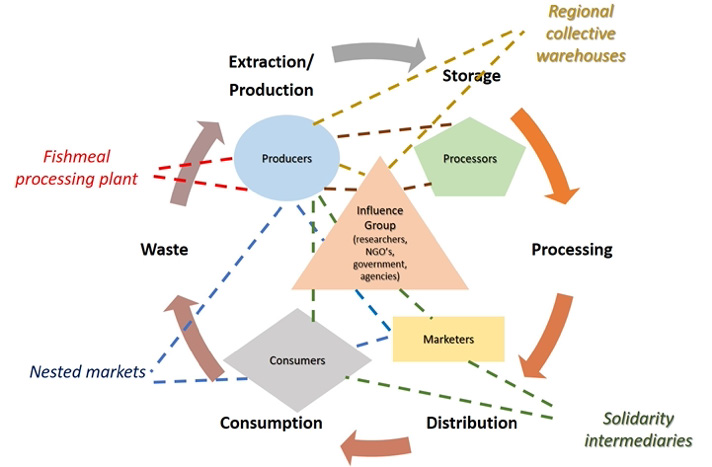
which is considered key for this type of study, is a participatory mapping of TPCC
bottlenecks and innovation niches in which the transdisciplinary team establishes
multi-stakeholder alliances and the mobilization of actions that could be leveraged
to begin the transition towards fairer and relocated food systems (Figure 4). It is expected that the map obtained will also be presented to the rest of the
social actors that form the nodes of the study area (processors-distributors, marketers
and consumers) for their information and feedback. Based on their analysis and contributions,
they will have proposals for new practices that can be complementary to the alternatives
proposed by the small-scale producers. As examples of new practices related to food
systems that have taken place in different Mexican territories, the following four
major niches of territorial innovation that could arise in the methodological case
in question are listed below:
-
Implementation of a regional food relocation action plan: based on food complementarity
between coastal and inland areas, as well as proximity access for urban and peri-urban
popular sectors.
-
Development of a lobbying agenda for national and international funds, as well as
regional alliances: to expand local storage and processing capacities for fishery
and agricultural products and promote new production mobility schemes that include
the acquisition of community means of transportation, as well as chartering and solidarity
intermediation systems.
-
Holding of a series of workshops aimed at promoting food culture and nutritional
health: based on the consumption of regionally produced fish and agricultural foods
and the recovery of local gastronomies.
-
Promotion of social economy schemes: to encourage the emergence of associative figures
of production, consumption, savings and loans that favor the supply of food within
local livelihoods.
Figure 4
Participatory mapping of opportunities for niche innovation in the local food system
based on the establishment of synergies between actors in the territorial production-consumption
circuit.
Source: Own authorship.
Challenges and limitations of the proposal
A first possible obstacle to carrying out the proposal is financial, given that adequate
funding must be sought for it. We also agree with the proposal of García-Barrios (2019, 10), who states that the potential obstacles in any Mexican and Latin American research
and transformation project, such as the one presented here, could be of three types:
“1) The obstacles to design and build the appropriate intervention instruments; 2)
the obstacles to form the social subjects willing and able to transform the situation;
and, 3) the obstacles (legal, ethical, cultural, etc.) to transform the field of action.”
To point 2, it should be added that “Such cooperation should be led by well-organized
regional communities” (García-Barrios 2019, 9). In the Mexican case, this implies a problem because the neoliberal governments
of past periods implemented subsidy programs of a welfare nature, which accustomed
many communities to be passive and not to exercise their own initiative in seeking
local solutions to their productive problems. This represents a challenge for research
and transformation projects, especially for the Mexican fishing sector, where some
small-scale fishers have recently informed us that their sector suffers from considerable
organizational problems (see also Cisneros-Mata et al. 2023).
One of the most important obstacles could be of an economic-political nature. For
example, we foresee that, once the RIT collect the data of the social and commercial
subjects that form the map of the current TPCC circuits of fish and agricultural products,
it will also become known which of them have more economic and political power. That
is, more decision-making power over the structure and function of the studied circuit
in the fishing sector; as researchers did in the TPCC circuit of octopus (Coronado et al. 2020), as well for beef in the peasant farming sector studied by Rivera-Núñez et al. (2020). Our expectation is, as has been seen in other territorial TPCC circuits in Mexico
and Latin America, that those with the greatest economic-political power will be the
social subjects of the group of entrepreneurs, who generally have the support of the
authorities such that, as a whole, they are referred to as the economic-political
group; while those with less power will be the small-scale fishers and farmers themselves
(Bello-Baltazar et al. 2020; Coronado et al. 2020). A possible constraint to any transformation of the status quo will therefore be whether the balance of power would allow the new practices or innovation
niches proposed by small-scale producers in the territorial TPCC circuits to be carried
out.
Concluding remarks
The exclusion processes of the global food regime for small-scale fishers and farmers
in Mexico can be approached from several perspectives. The present study used our
context-specific transdisciplinary experience, which derives from almost three decades
of working closely with local communities, civil organizations, government agencies
and research groups in the Yucatan Peninsula. Consequently, we have identified that
the complex processes of exclusion of the global food regime act under a structuring
process of neoliberalism where, to date, there has been a gradual dismantling of Mexican
fishing and agricultural means of production, commercial organization and food sovereignty.
Such productive, commercial and food dismantling is the result of how the nation-State
respond to the logics of global agreements known as “conditionality lending” (De Moerloose 2014; Vordtriede 2019, 1), where signatory countries, like Mexico, modify their laws and carry out structural
reforms following a development agenda dictated by the financial institutions that
grant them the loans. The conditionality lending encompassing modification of national
laws together with structural reforms has been taking place in other Latin American
countries as well, including Argentina, Bolivia, Brazil, Cuba, Colombia, and Honduras
(Bello-Baltazar et al. 2020). In the case analyzed in our study, since small-scale producers are at the bottom
of the market linkage, they present precarious income conditions and very little maneuverability
in terms of their commercial process in regional and national markets. As a result,
many coastal and agricultural communities tend towards food insecurity. In relation
to this problem, we do not consider that the Mexican government has the full capacity
to maneuver in the short term to help these food systems and rural producers to improve
their situation. Our proposed transdisciplinary approach is therefore based on the
argument that collaboration between social subjects of the LSES, mainly between the
group of producers and academia, is fundamental in order to reverse the conditions
of vulnerability imposed by global food regimes in those territories without explicit
manifestations of social mobilization (Herrera and Guerrero-Jiménez 2020). Other actors, such as thoughtful consumers and solidarity intermediaries, must
play a central role in collaborating to construct new local commercial networks or
nested markets (Van der Ploeg et al 2022) and a place-based food culture, given the lack of localized scope of public policies.
In this collaboration, mainly fishers and farmers will make use of their visions to
identify and enable innovation niches, in such a way that will allow them to articulate
in complementary TPCC circuits of fish (of medium and lower economic value) and basic
agricultural products that connect coastal areas, the rural hinterland and small and
medium-sized cities within micro or meso regional contexts.
In order to confront the food regime, beyond prescribing some of the demarcated ideological
and mobilizing positions that have already figured in the heated international food
debate (such as food security, food sovereignty, food self-sufficiency, the right
to food, food autonomy, among others), we have chosen to outline those operational
features that can lead to the relocation of the food systems. In our bid for food
relocation, the complementarities between fishing and farmer communities, as well
as between small and medium cities play a central role, due to the geographical proximity
of less than 200 km between coastal and inland areas that occurs in the Yucatan Peninsula,
as well as in many regional contexts of the country, mainly in the west, south-southeast
and Gulf of Mexico. It is possible to put into practice the transdisciplinary proposal
outlined in this work, because during the COVID-19 sanitary contingency we witnessed
the solidarity food complementarities between small-scale fishing and farming families
in contiguous communities, as well as the emergence of alternative food supply networks
in the cities and in rur-urban areas of the Yucatan Peninsula. Lastly, we consider
that this proposal is broadly flexible for use in multiple contexts that share the
fishing, agricultural and popular consumer proximity, mainly in the Global South and
with some focus on the Latin American region.